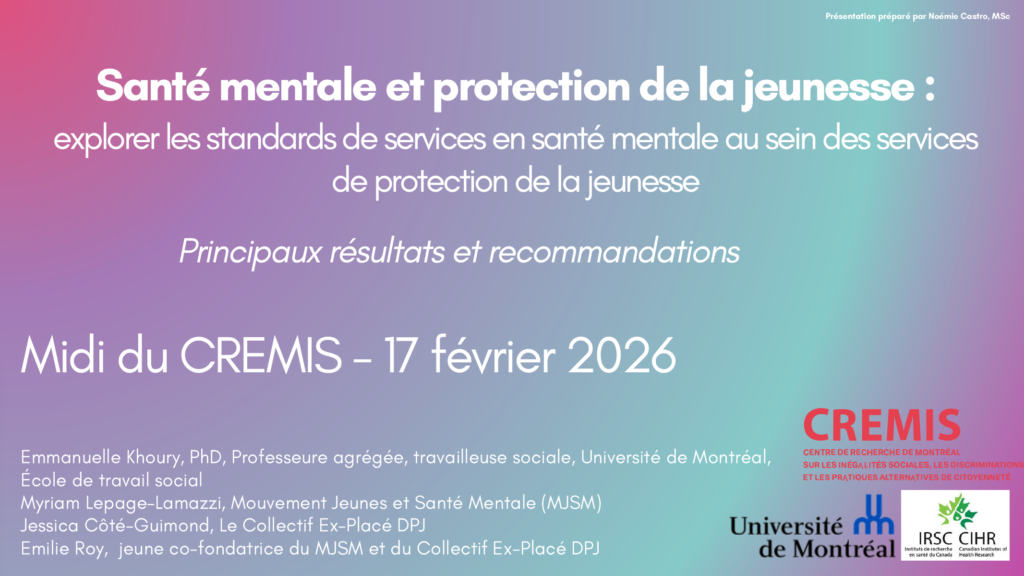
Webinar: Toward Standards for Mental Health Services for Children and Youth in Child Protection – Midi-CREMIS, February 17, 2026
On February 17, 2026, as part of a lunch and learn event with the Centre de Recherche de Montréal sur les inégalités sociales, les discriminations et les pratiques alternatives et citoyennes, we had the pleasure of presenting the results of the research project “Mental Health and Child Protection: Exploring Mental Health Service Standards within Youth Protection Services.” This study aims to support equitable and appropriate access to mental health services throughout the child protection trajectory, including the transition to adulthood.
The main objective of the research is to formulate evidence-informed recommendations that help improve practices and guide the development of standards.
After meeting with 44 key stakeholders — including young people formerly placed in care — our recommendations for developing mental health standards within youth protection services emphasize the need to ensure:
- A coordinated circle of care
- Clear guidelines for complex needs
- Meaningful inclusion of young people’s voices
- Stability and consistency
- Shared decision-making
- Relational approaches
- Recognition of traumas
- Trauma-informed practices
- Support and training for staff
- A holistic view of well-being
A Presentation Rich in Perspectives
The first part of the session featured a presentation of the main research findings, led by the principal researcher, Emmanuelle Khoury, PhD.
The second part opened the floor to an inspiring discussion with:
- Myriam Lepage-Lamazzi (Mouvement Jeune et Santé Mentale)
- Jessica Côté-Guimond (Collectif Ex-placé DPJ)
- Émilie Roy (youth expert, co-founder of Mouvement Jeune et Santé Mentale and Collectif Ex-placé DPJ)
Five Areas for Reflection and Action
The discussions were structured around five central themes:
- From research to action: building collective responsibility
- A system that harms: a macro and systemic perspective
- Invisible trauma, inaccessible knowledge: what do youth in care know about trauma?
- Equitable standards or standardized equity? When standards are not enough
- Hope is not naïve: it is relational, shared, and grounded in action
These rich exchanges highlighted a shared vision: a more coherent system, better aligned with the real needs and desires of young people, and rooted in fair, accessible, and hope-driven practices.